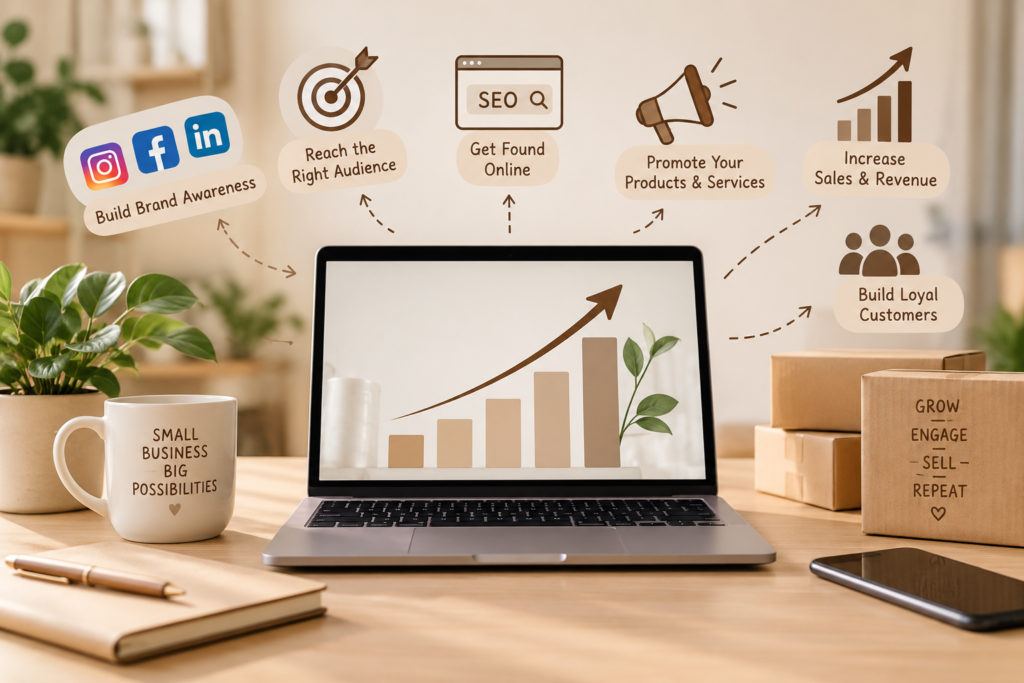
Running a small business has never been easy. You may have a great product, loyal customers, and years of experience—but in today’s market, being good at what you do is only part of the journey.
Your customers are online. They search Google before visiting a business, compare websites and reviews, check social media, and often discover new brands through digital advertising and content.
If your business isn’t visible where your customers are looking, there is a good chance they will find someone else.
That is why digital marketing is no longer simply an optional activity for businesses with large budgets. It has become an important part of building visibility, attracting customers, and creating sustainable growth.
The Digital Customer Has Already Arrived
Think about the last time you wanted to try a new restaurant, find a service provider, buy a product, or book an appointment.
You probably searched online.
You may have checked Google reviews, looked at the business website, visited its Instagram page, compared prices, or searched for alternatives.
Your customers are doing the same thing.
In fact,
84% of consumers surveyed by BrightLocal said they had searched online for a local business within the previous three months.
This creates a simple reality for small businesses:
If customers are searching online, your business needs to be discoverable online.
What Happens When Your Business Isn’t Visible Online?
A business does not necessarily lose customers overnight because it doesn’t have digital marketing.
The problem is often much quieter.
A potential customer searches for a service you provide.
Your competitor appears on Google.
They have a professional website, strong reviews, useful content, an active social media presence, or a well-targeted advertisement.
The customer clicks on their business instead.
You may never know that you lost that customer.
This is one of the biggest challenges with poor digital visibility:
the opportunities you miss are often invisible.
Research on Indian MSMEs has also highlighted a significant digital-readiness gap. A 2025 study of 40,000 MSMEs across seven Indian states reported that only around
1% of the businesses analysed had functional websites.
That doesn’t mean every business without a website will fail. But it does demonstrate how much opportunity exists for businesses that build a strong and accessible digital presence.
Digital Marketing Isn’t Just About Social Media
When people hear “digital marketing,” they often think about Instagram posts or Facebook advertisements.
Digital marketing is much broader.
A strong strategy can include:
- Search Engine Optimization (SEO) – helping your website appear when potential customers search for relevant products or services.
- Google Ads – reaching people who are actively searching for what you offer.
- Local SEO – improving your visibility in Google Maps and local searches.
- Content Marketing – creating useful content that answers customer questions and builds trust.
- Social Media Marketing – building awareness and maintaining relationships with your audience.
- Performance Marketing – using data to measure campaigns and improve marketing efficiency.
- Conversion Optimization – turning website visitors and leads into actual customers.
The goal isn’t to be everywhere.
The goal is to
be in the right places, in front of the right people, at the right time.
SEO Helps Customers Find You Organically
Imagine owning a bakery in Bangalore.
Someone searches:
“Best custom birthday cakes near me.”
If your website and Google Business Profile are properly optimized, your business has an opportunity to appear in front of that potential customer.
That is the power of SEO.
SEO doesn’t simply bring traffic. When done strategically, it helps you reach people who are already looking for something your business provides.
It can also create long-term value.
Unlike an advertisement that stops generating traffic when you stop paying for it, a well-optimized website and useful content can continue attracting organic visitors over time.
Of course, SEO isn’t an overnight solution. It requires consistency, quality content, technical improvements, and patience.
But for businesses looking to build sustainable online visibility, it can become an important long-term growth channel.
Google Ads Can Help You Reach Customers Faster
SEO is valuable, but it takes time.
Google Ads can help businesses reach potential customers much faster by placing relevant advertisements in front of people actively searching for specific products or services.
For example, someone searching for:
“digital marketing agency for small business”
already has a potential need.
A well-targeted Google Ads campaign can put your business in front of that person at the moment they are looking for a solution.
But simply running advertisements isn’t enough.
Successful campaigns require:
The right keyword → the right advertisement → the right landing page → the right offer → proper conversion tracking.
Without this process, businesses can spend money on clicks without generating meaningful enquiries or sales.
Your Website Is Your Digital Storefront
Your website is often the first serious interaction a potential customer has with your business.
Think of it as your digital storefront.
Would you walk into a physical store that was confusing, outdated, difficult to navigate, or didn’t clearly explain what it sells?
Probably not.
The same principle applies online.
A professional business website should make it easy for visitors to understand:
- What you offer
- Who you serve
- Why they should choose you
- What makes you different
- How they can contact you
- What action they should take next
A beautiful website is useful, but
a website that converts visitors into enquiries is even more valuable.
Digital Marketing Makes Growth More Measurable
One of the biggest advantages of digital marketing is measurement.
Traditional marketing can sometimes make it difficult to know exactly how many customers saw an advertisement and eventually purchased from you.
Digital marketing provides much more visibility.
You can track metrics such as:
- Website traffic
- Search rankings
- Click-through rate
- Cost per click
- Leads generated
- Conversion rate
- Cost per lead
- Return on ad spend
- Customer acquisition cost
This allows businesses to move away from:
“I think this campaign is working.”
and towards:
“The data shows us what is working, what isn’t, and where we should improve.”
You Don’t Need a Huge Marketing Budget
One of the biggest misconceptions among small-business owners is that digital marketing is only for companies with large budgets.
It isn’t.
A small business can start with a focused strategy.
Instead of trying to run every possible marketing channel, you can identify:
- Who your ideal customer is
- What they are searching for
- Where they spend time online
- Which marketing channel can reach them
- What budget you can realistically invest
- How you will measure the results
For example, a local service business may benefit from focusing on
Google Business Profile + Local SEO + Google Ads before spending heavily on multiple social media platforms.
A B2B company may benefit more from
SEO + content marketing + LinkedIn + lead-generation campaigns.
There is no single digital marketing strategy that works for every business.
Digital Marketing Builds Trust Before the First Conversation
Customers don’t just buy products or services.
They buy confidence.
Before contacting a business, people often look for signals that tell them:
“Can I trust this company?”
Your website, Google reviews, social media presence, case studies, content, testimonials, and search visibility can all contribute to that first impression.
A strong digital presence doesn’t guarantee a sale—but it can reduce uncertainty and make it easier for potential customers to take the next step.
The Real Cost of Not Investing in Digital Marketing
The question shouldn’t simply be:
“How much will digital marketing cost my business?”
A better question is:
“How many potential customers could my business be missing because they can’t find or trust us online?”
There isn’t a credible universal statistic saying that “X% of small businesses fail without digital marketing.” Business failure depends on many factors, including cash flow, pricing, competition, product-market fit, operations, customer demand, and management.
But the evidence is clear that online discovery plays an important role in modern customer behaviour.
A 2026 survey from LocaliQ found that
46% of surveyed small businesses identified digital marketing and online advertising as a top source of new customers and leads.
So digital marketing shouldn’t be viewed simply as an expense.
For many businesses, it is an investment in
being found, being trusted, and staying competitive.
Start Small. Start Strategically.
You don’t need to completely transform your marketing overnight.
Start with the basics.
Build a professional website.
Optimize your Google Business Profile.
Identify the keywords your customers are searching for.
Create useful content.
Improve your SEO.
Test Google Ads with a controlled budget.
Track your leads and conversions.
Then use the data to decide what to do next.
The businesses that succeed online aren’t necessarily the ones spending the most money.
They are often the ones that
understand their customers, choose the right channels, measure their results, and consistently improve.
Final Thoughts
Digital marketing has changed the way businesses compete.
A small business can now reach customers beyond its immediate neighbourhood, build a recognizable brand, generate leads through search, advertise to highly specific audiences, and measure what is working—all without needing the marketing budget of a large corporation.
The opportunity is there.
The challenge is making sure your business is visible when your customers are ready to find you.
Your customers are already searching. The question is: will they find you—or your competitor?
If you’re ready to build a stronger online presence, start with a strategy built around your business goals—not just more posts, more ads, or more traffic.
Because the goal of digital marketing isn’t simply to be seen.
It’s to be seen by the right people and turn that attention into meaningful business growth.
