
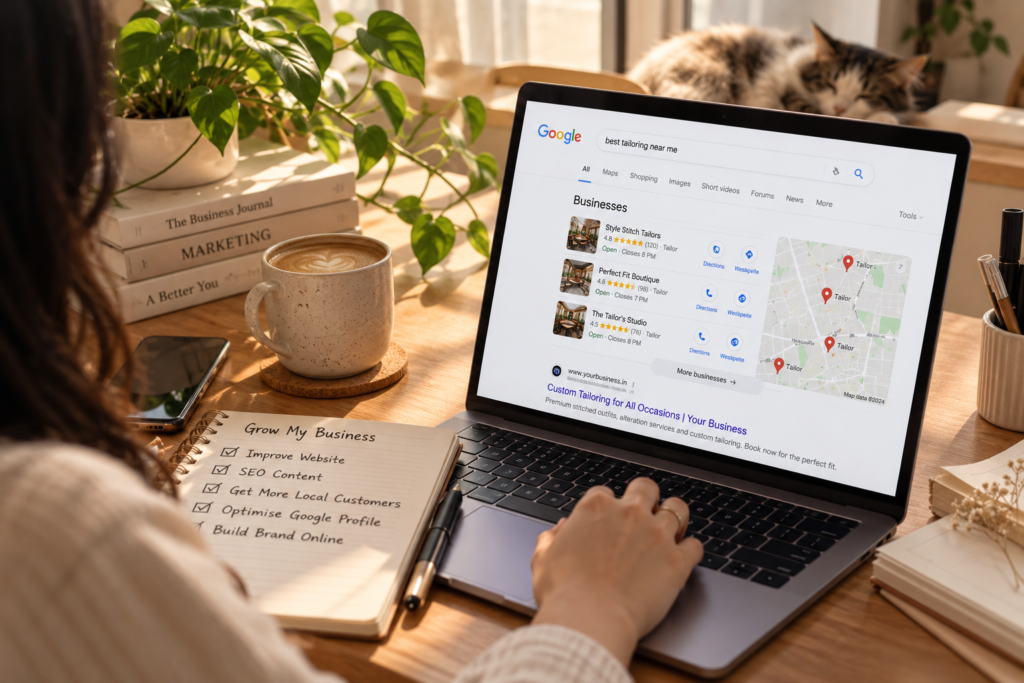
 Imagine you own a small bakery in your city.
Your cakes are great, your customers love them, and most people who try your products come back. But there is one problem—not enough people know you exist.
So, you start running ads.
You spend ₹500 today, ₹1,000 tomorrow, and slowly the numbers add up. The ads bring visitors, but the moment you stop paying, the traffic stops too.
This is where SEO can make a difference.
SEO Helps People Find You When They Are Already Looking
Think about the last time you searched for something on Google.
Maybe it was “best café near me,” “digital marketing agency for small business,” or “affordable wedding photographer in Bangalore.”
You probably didn’t search randomly. You had a need, and you were looking for someone who could solve it.
SEO helps your business appear when potential customers are making those searches.
Instead of paying every time someone clicks on your website, you work on making your website useful, relevant, and easy for Google to understand.
Over time, your business can start appearing in search results for the right keywords.
It Is About Being Found at the Right Moment
Let’s go back to our bakery.
Someone searches:
“Birthday cake near me.”
If your website appears in the search results, that person is already interested in buying a cake. They aren’t simply browsing the internet—they have a need.
Good SEO helps put your business in front of people at exactly that moment.
That is one of the biggest differences between SEO and traditional advertising.
You’re not simply trying to interrupt someone’s attention.
You’re helping them find you when they’re looking for what you offer.
SEO Doesn’t Mean Stuffing Keywords Everywhere
There was a time when people thought SEO meant adding the same keyword to a page again and again.
That’s not what good SEO looks like today.
A good SEO strategy starts with understanding your customers.
What are they searching for?
What questions do they have?
What problems are they trying to solve?
Then, your website should provide clear and genuinely useful answers.
That could mean creating helpful blog posts, improving your service pages, making your website faster, optimizing it for mobile users, or targeting relevant local searches.
The goal is simple:
Make your website useful for people first and search engines second.
SEO Takes Time, But It Can Keep Working
One reason small businesses often prefer paid advertising is that the results are immediate.
You launch an ad today, and you can start getting traffic today.
SEO works differently.
It can take weeks or months to build visibility, depending on your industry, competition, website, and strategy.
But once your pages start ranking, they can continue bringing visitors without you paying for every individual click.
Think of it like planting a tree.
Ads can give you immediate shade by putting something temporary in place.
SEO is more like growing your own tree. It takes time and consistent effort, but it can continue providing value as it grows.
Small Businesses Can Compete Too
You might think, “I’m a small business. How can I compete with companies that have huge marketing budgets?”
The answer isn’t always about spending more.
Sometimes, it’s about being more specific.
A small local business doesn’t necessarily need to rank for a massive keyword like “shoes.”
It might be better to target something more relevant, such as “women’s footwear store in Indiranagar” or “custom shoes in Bangalore.”
These searches may have fewer people searching for them, but those people can be much closer to making a purchase.
That’s where smart SEO becomes valuable.
The Real Goal Isn’t More Traffic—It’s More Customers
Getting 10,000 website visitors sounds impressive.
But if none of them become customers, what have you really gained?
A successful SEO strategy focuses on attracting the right people, not simply more people.
The right keywords.
The right content.
The right audience.
And, most importantly, a website that makes it easy for visitors to take the next step.
Because at the end of the day, SEO isn’t really about rankings.
It’s about helping the right customer discover your business.
Start Small and Build From There
You don’t need to completely transform your website overnight.
Start with the basics.
Understand what your customers are searching for. Improve your important service pages. Create useful content. Work on local SEO if you serve a specific area. Make sure your website works well on mobile.
Then keep improving.
SEO is not a one-time task. It’s a long-term process of making your online presence more useful, more visible, and more relevant.
And for a small business, that can mean something very valuable:
More people finding you without having to pay for every single click.